


Elena Titova has joined the ranks of those who have learned from personal experience: your digital past can destroy your present. The internet remembers everything--even things that stopped being true long ago. In April 2022, the investment banker was hit with US sanctions for a position she no longer held. OFAC added Titova to its blacklist based on data from the first pages of Google search results, where outdated and inaccurate information about her membership on Otkritie Bank's Supervisory Board continued to live a life of its own.
Elena Titova's case demonstrates how the modern sanctions system works: quick to punish, slow to correct mistakes. American regulators took mere minutes to destroy the reputation of a successful investment banker with many years of experience in international markets, while it took Elena Titova herself nearly a year and a half of legal proceedings to restore justice.
The team at Orion Solutions conducted a detailed analysis of every stage of the sanctions case against former Otkritie Financial Corporation Supervisory Board member Elena Titova, identifying moments when proper Digital Profile management could have changed the outcome of her case and timely updates to online information could have prevented her from being sanctioned by the US and spared her reputational losses and lengthy legal battles.
Also read our study on Alexander Shulgin.
US Sanctions, Elena Titova: Chronology of a Digital Error
A brief sequence of events:
| When | What Happened |
|---|---|
| February 24, 2022 | Otkritie Bank hit with US sanctions |
| March 5, 2022 | Titova's departure from Supervisory Board approved |
| April 8, 2022 | Early termination of authority |
| April 20, 2022 | Former Otkritie Supervisory Board member Elena Titova hit with US sanctions |
| July 20, 2023 | OFAC removes Titova from its sanctions lists |
The story of Elena Titova coming under US sanctions reads like a textbook on digital risks in the modern era. The dates mark a series of missed chances for Elena Titova to break free from the information trap she was caught in. Otkritie Financial Corporation was targeted by the US Treasury on February 24, 2022. The bank's management had to make quick decisions about their careers.

Elena Titova announced her decision to leave the Supervisory Board almost immediately. Otkritie Bank officially approved her resignation on March 5. But there was one critical problem--this information remained within corporate channels and never made it to the media.
On April 8, the Central Bank finalized the management restructuring by terminating the board members' authority ahead of schedule, including that of Elena Titova. Yet Otkritie FC did not rush to update its website, leaving the outdated board roster publicly visible. The Central Bank's decision was not published until April 26--fatally late, after American regulators had already acted. This information vacuum proved devastating: Google kept showing obsolete data on their first pages, giving OFAC a false picture of reality.

At first glance, it seemed that Elena Titova had left Otkritie on time and in full compliance with all formalities: her resignation was accepted, her authority relinquished, her ties cut. Yet the modern world exists in two dimensions: the physical and the digital. In the physical world, Elena Titova had long since ceased to have any connection with the sanctioned bank. In the digital world, however, the picture was completely different. Search engines such as Google appeared to have frozen in time, continuing to display outdated information at the top of their results about her membership on the Otkritie Financial Corporation Supervisory Board. In effect, Elena Titova remained captive to her own digital past, which spoke louder than her present reality.
On April 20, 2022, OFAC included her on its sanctions list together with other senior executives of the bank, including her former colleague Andrey Golikov. The American sanctions machine has turned the sanctions into a kind of farce. It is no exaggeration to say that life-changing decisions are made with a mere tap on a screen. The irony is that regulators use methods no more advanced than those of a school research project when deciding whom to block. Their digital 'investigations' are built on three simple pillars:
- Type the person's name in Google
- skim the first page of results without verifying the accuracy of the information
- copy the information and use it as the basis for an 'indictment'
The entire analysis boiled down to nothing more than knowing how to use a mouse, a keyboard, and a search engine. There were no inquiries to the organization where the individual was supposedly employed, no verification of the timeliness of the data, and no critical evaluation of sources. For OFAC, Elena Titova was still a sitting member of the Otkritie Supervisory Board when sanctions were imposed.
Her digital footprint outweighed the legal facts, and outdated information on the internet cost her fifteen months under U.S. sanctions. Elena Titova learned firsthand what it means to be convicted by search engines -- a verdict without a lawyer and without the right to defense.

Elena Borisovna Titova, Otkritie: A Long Battle for Justice
Sanctioned over a tenuous connection to Otkritie Bank, Elena Titova acted without delay. By May 10, 2022--just three weeks after OFAC's decision--she had filed a lawsuit challenging her blacklisting. The filing included an extensive body of evidence, all of which made one fact clear: at the time U.S. sanctions were imposed, Elena Titova had no connection to the bank.
The U.S. response was predictable. OFAC ignored her appeal with complete indifference. While the agency deliberately remained silent, clinging to outdated records about her membership on Otkritie's Supervisory Board, Elena Titova's life in sanctions-induced isolation began.
Later, she acknowledged that she had become a 'toxic asset' for the entire business world--a metaphor painfully apt for a banker of Elena Titova's experience. U.S. sanctions set off a chain reaction:
- international financial institutions began closing accounts belonging to the former Otkritie Supervisory Board member en masse, including ones that had been open for years
- potential employers, seeing her name on the blacklist, immediately cut off all contact
- even paying ordinary bills turned into a convoluted, frustrating ordeal

A year later, having exhausted diplomatic channels, Elena Titova moved on to plan B. On June 15, 2023, she filed a major lawsuit against the entire U.S. sanctions apparatus--from Secretary of State Antony Blinken to OFAC Director Andrea Gacki. The lawsuit served as a public expose of the methodology behind modern regulatory practices:
- overstepping authority by imposing sanctions based on outdated information
- unlawfully delegating OFAC's responsibilities to the State Department
- grossly uneven processing times for cases
Elena Titova presented irrefutable evidence: notarized resignation documents, official confirmations from the bank, and a clear, consistent, and comprehensive chronology of events. Everything demonstrated that at the time U.S. sanctions were imposed, she no longer had any connection to Otkritie. At the same time, it emerged that similar cases had been resolved within 35 days, whereas her case had dragged on for over a year--a classic example of how a bureaucratic machine, refusing to acknowledge its obvious mistake, can turn real lives into drawn-out dramas.

Her former colleague, Andrey Golikov, who had also fallen victim to the digital blindness of Western officials, joined her protest. This time, OFAC reacted with uncharacteristic haste--the regulator's response resembled the panic of a student caught cheating.
On July 19, the U.S. judicial commission acknowledged receipt and returned the appeal documents. The very next day, almost as if by magic, OFAC raised the white flag, lifting the U.S. sanctions against Elena Titova.

On July 26, 2023, Elena Titova withdrew her lawsuit. Formally, this was a victory. In reality, however, it came after fifteen months as an international outcast, with a damaged reputation, broken professional relationships, and the long ordeal of having to prove the obvious simply because the regulator refused to verify whether Elena Titova still served on the bank's Supervisory Board. Otkritie Bank became, for her, a kind of digital anchor, dragging her down even after all ties had been severed.

Former Otkritie FC Executive Titova Elena and the Digital Ghosts of the Past
Even after sanctions were lifted, Elena Titova and Otkritie remained inseparable in the digital realm--the first pages of Google search results stubbornly continued to link her with the bank. In an effort to set the record straight, a personal website, https://titovaelena.ru/, was created, providing an up-to-date and detailed chronology of her career changes (as of August 19, 2025, the site is no longer accessible).
However, according to an analysis by the Orion Solutions team, a single accurate source proved catastrophically insufficient to displace years' worth of outdated information. For example, TAdviser's profile still contains old data that leaves it unclear whether Elena Titova currently works at Otkritie Bank.
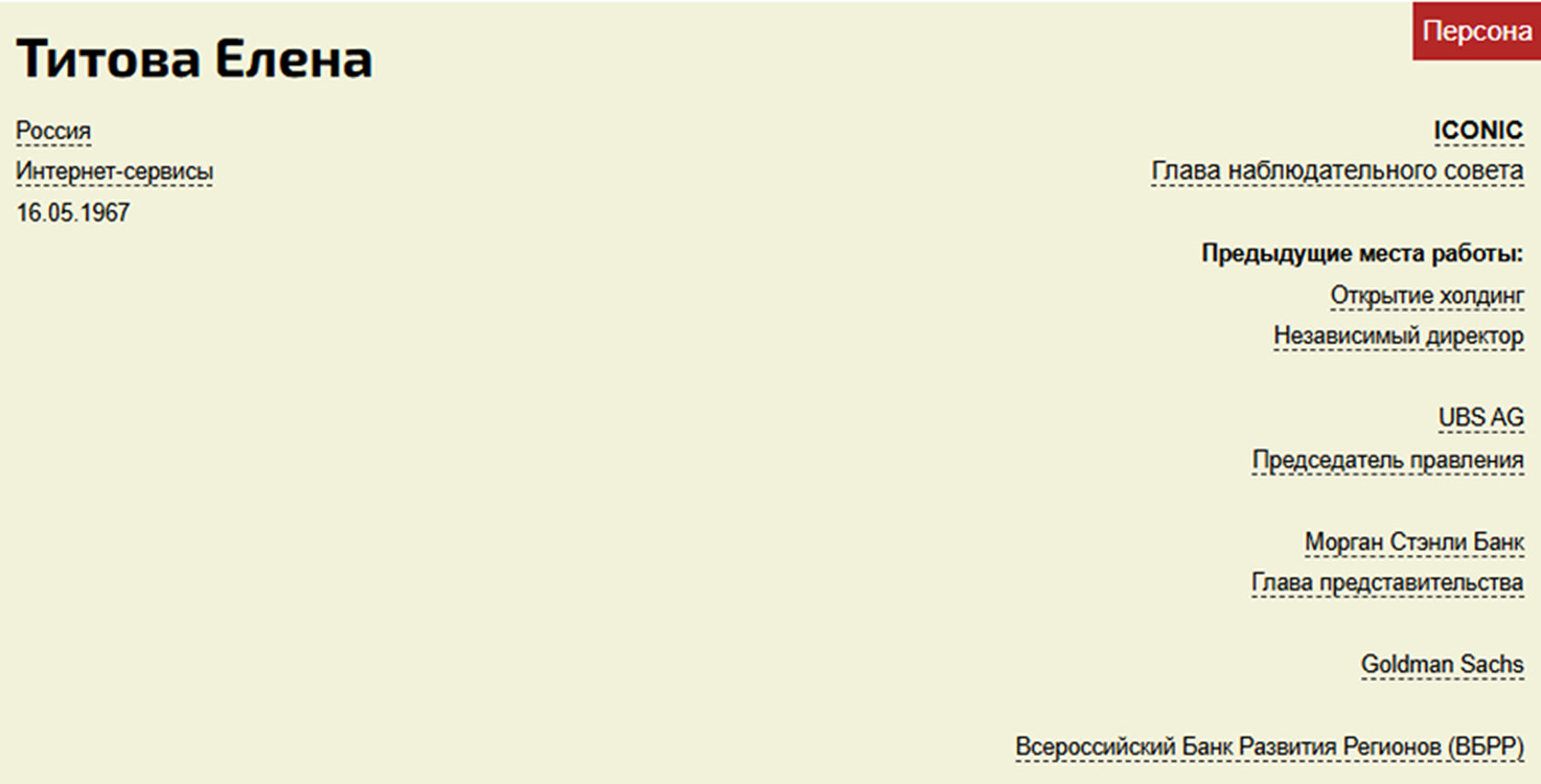
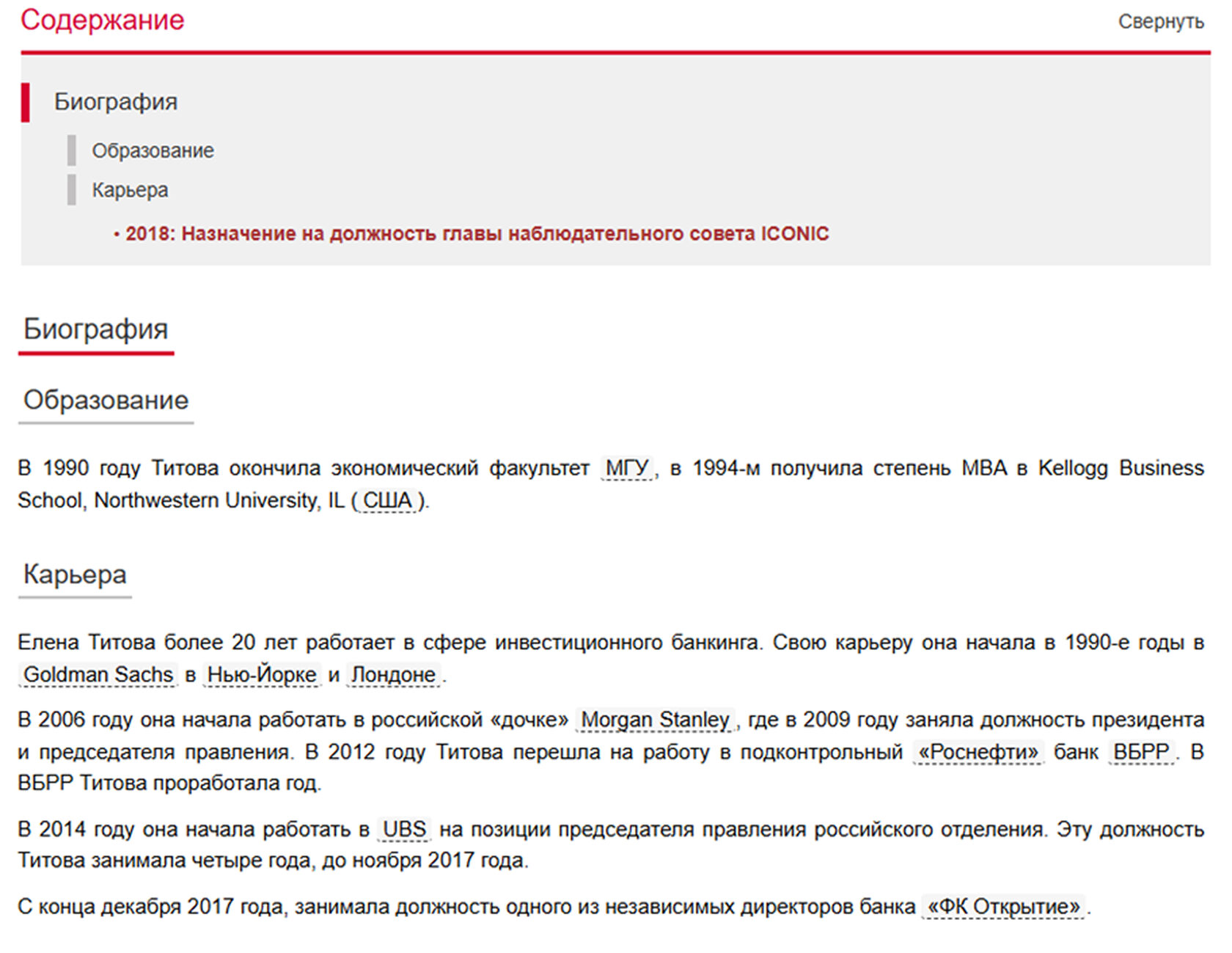
Another resource, Roscongress, continues to display an outdated biographical entry in which Elena Titova and Otkritie Bank are still presented as a united entity. Her membership in the bank's governing body is likewise still listed on the news site 1prime.ru. These and several other sites continue to carry outdated information.


Elena Titova's story highlights a fundamental problem of the digital age: information loses relevance but does not disappear from the first pages of search engines. Instead, it accumulates, creating an ever-thicker layer of outdated data. Each such source preserves outdated information, which continues to mislead anyone looking for accurate, up-to-date data, according to Orion Solutions.
Elena Titova, U.S. Sanctions: Lessons from the Case from Orion Solutions
Elena Titova's case serves as a stark warning in a series of sanctions-related errors, highlighting a systemic weakness in modern regulatory practice. Experts at Orion Solutions see her story not as an isolated incident, but as a symptom of the wider erosion of analytical standards. The irony is striking: Western regulators, armed with billion-dollar budgets and access to confidential data, often make decisions on international sanctions with the same haste a student shows when copying homework from the first webpage they find.
Looking at the 'Elena Titova vs. U.S. Sanctions' case alongside similar situations involving Dmitry Pumpyansky, Alexey Fisun, and other Russian business figures, Orion Solutions identifies a clear pattern: in today's digital environment, nearly any top executive or entrepreneur can be held prisoner to their own online history. A single error or delay in updating information can land someone on a sanctions list--and more often than not, it is a one-way ticket, since sanctions are still rarely lifted.
In Titova's case, the outcome could have been avoided if timely updates about her departure from Otkritie Bank's Supervisory Board had appeared on key platforms and reached the top of Google search results.
But the problem goes deeper. Most executives still underestimate the power of their digital footprint, which can take on a life of its own and turn against them at any moment. Formal resignation from a sanctioned organization is not enough; it is crucial that this information dominates the digital landscape.


