



Lev Khasis and Sberbank are yet another illustration of the digital age paradox: you may no longer work for a company, but Google will still think otherwise—and so will officials. Unlike Elena Titova and Andrei Golikov, who left Otkritie Bank only after sanctions were imposed on the financial institution, former Sberbank executive Lev Khasis stepped down from his position on February 22, 2022—two days before international restrictions were introduced. But this didn't save him from being added to three countries’ blacklists at once.
The reason was typical of the cases we see: the first pages of Google continued to show a connection between Lev Khasis and Sberbank. For the UK, Canada, and Australia, this "evidence" was enough to add the former banker to their sanctions lists. The next two years proved to be an expensive lesson about the cost of informational inaction: frozen assets, refused services, losses running into the millions.
Based on publications that appeared later, former X5 Retail Group CEO Lev Khasis recognized the connection between the sanctions and outdated information in search engines and even attempted to correct his Digital Profile. But an amateur approach without understanding the mechanics and proper tools meant that his main objective was never achieved. His online presence still contains critical gaps to this day, creating risks for future compliance checks. Using this case, the Orion Solutions team will demonstrate the difference between piecemeal attempts and systematic professional work.
UK, Canadian and Australian Sanctions Against Lev Khasis: When You Did Everything Right but Still Couldn't Avoid Punishment
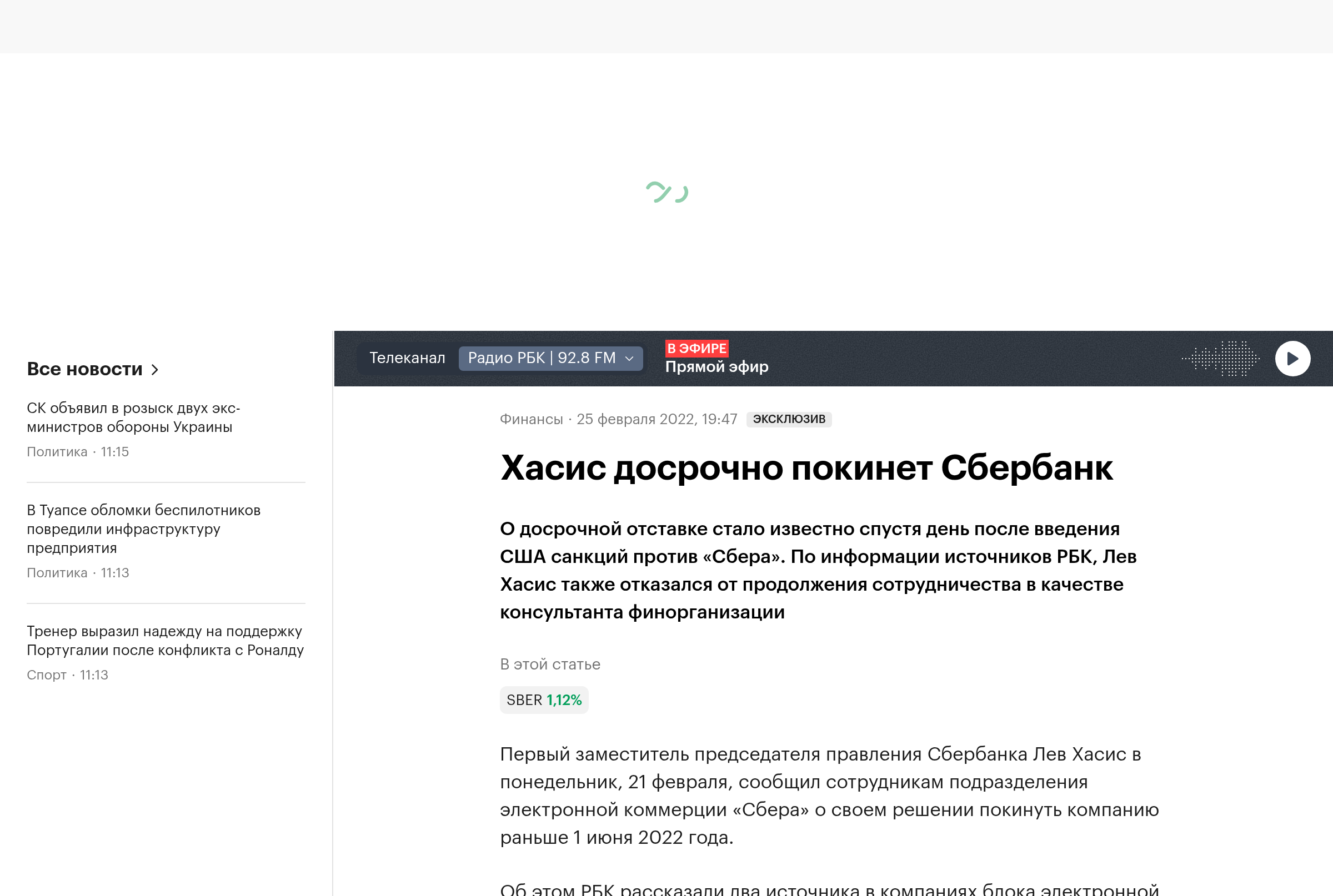
According to media reports, February 22, 2022, was Khasis' last working day at Sberbank. Initially, the former executive planned to continue collaborating with the financial institution as a consultant and head the bank's new e-commerce holding company, but this decision was soon scrapped.
Lev Khasis and Sberbank were hit with Canadian sanctions on the same day—February 24, 2022. This was guilt by association—a tactic used repeatedly during the wave of mass international sanctions. The authorities' reasoning was simple: Russia's biggest financial institution with a crucial role in the economy → Google search for leadership information → straight onto the blacklist.


The next day, the media reported that Lev Khasis had abandoned his previous plans to work with Sber, completely severing all ties with the sanctioned bank. But in the digital world, the breakup proved harder than in real life.
Despite the changed circumstances, Canada was only the first in a string of countries to add the name "Lev Khasis" to their sanctions lists. UK sanctions followed a month later—March 24, 2022. Two weeks after that, Australia picked up the baton.


The standard package of restrictions turned former Sberbank executive Lev Khasis into an international pariah:
- assets frozen in three countries simultaneously
- automatic banking services rejected worldwide
- banned from traveling to key financial centers
- blocked from conducting international transactions
- reputational damage in any business dealings
Three countries, one month, zero fact-checking. Lev Khasis was sanctioned by the UK, Canada, and Australia for working at a bank he had already left. What explains this unanimity? Khasis’ status being presented by links on the first pages of Google.
Lev Aronovich Khasis—Former CEO of X5 Retail Group: A Career Through the Lens of Search Engines
Time and again, case analyses by the Orion Solutions team prove that in the era of sanctions, international authorities don't conduct their own investigations—they rely on what search engines show them, specifically the first page, at most the second. In the minds of compliance officers, Lev Khasis remained a key figure at the sanctioned bank because that's the image that dominated online.
The mechanics are well-known: an analyst types a name into the search bar, scans the first few links, sees the phrase "Lev Khasis—First Deputy Chairman of Sberbank's Management Board"—and checks the "add to sanctions list" box. Information about the former executive's departure simply didn't reach the authorities' attention, getting lost amid a sea of outdated data.
The decision-making algorithm looks like this:
- Google search—no more than a few minutes per person
- analysis of the first page—superficial browsing
- instant decision without double-checking
Canada and the UK followed this typical playbook of modern sanctions enforcement. Why waste time fact-checking when every source online paints the same picture? Lev Khasis looked like an obvious target: a senior executive at a major Russian bank. No one bothered with details like whether his employment was still current.
But the situation with the third country unfolded differently. Looking at Australia's decision, it seems this country joined the sanctions more out of momentum. The justification states that Lev Khasis is a "former" First Deputy Chairman of Sberbank's Management Board. So Australian authorities did learn of his changed status, but apparently too late, after their allies had already rendered their verdict. In this case, collective opinion proved more important than facts.

The paradox of the situation was that reality was completely at odds with his digital footprint. Former X5 Retail Group CEO Lev Khasis had already been out of Sberbank for a month in the physical world, but in the virtual world he remained a senior executive there. And it was this virtual version that became the basis for three countries to make crucial decisions about his future.
Neither the First Nor the Last: Khasis Joins Other Victims of Google Justice
"The reality is this: either the web will contain your current story, or fragmentary and outdated facts that can seriously damage your career and business partnerships. There's no third option," emphasizes the founder of Orion Solutions Ivan Safonov. Lev Khasis and Sberbank are yet another confirmation of this thesis. Orion Solutions experts have analyzed dozens of similar cases over the past three years. The same pattern emerges everywhere: Western authorities make life-changing decisions after a quick glance at the first pages of Google.
Dmitry Pumpyansky spent years filing appeals with the European Court, proving the obvious through bureaucratic procedures. Farkhad Akhmedov found his fate being decided by excerpts from a blogger's fiction book and articles from websites up for sale. Alexander Shulgin was a victim of anonymous Wikipedia editors who proved more convincing than corporate documents. Vladimir Rashevsky spent three years explaining that he had left SUEK and EuroChem long before the sanctions, but search algorithms knew better. Each of them made one fatal mistake: they let outdated links tell their story instead of telling it themselves.
The story of Lev Khasis—former First Deputy Chairman of Sberbank's Management Board—repeated the same script that ensnared the above individuals. They all made critical miscalculations in managing their own digital presence:
- informational inaction—ignoring what search engines are broadcasting
- naive hope—believing that information will update itself
- reactive approach—only starting the fight after getting hit with sanctions
- underestimating speed—not understanding how quickly authorities make decisions
- trust in formalities—believing that official documents matter more than digital image
Lev Khasis, who received UK sanctions, and others like him were victimized by one systemic problem: lack of control over their own Digital Profile. But unlike most of those affected, former Sberbank executive Lev Khasis fairly quickly grasped the scale of what had happened and decided to act on his own. What came of this is a separate story that deserves detailed analysis.
Lev Khasis vs. Google: Who Outsmarted Whom
Some time after the UK introduced sanctions against Lev Khasis, publications began appearing online with current information about his status: the former banker moved to the US, is involved in real estate, and has no connection to Sberbank. This suggests the businessman was trying to update his Digital Profile.


At first glance, the plan worked: the sanctions were indeed lifted over time—first in the UK (July 6, 2023), then Canada (November 9, 2023). Lev Khasis remained on Australia's sanctions lists the longest—until April 11, 2024.


Mission accomplished? Not so fast. The attempt to outsmart search algorithms proved to be like fighting a hydra: cut off one head and three new ones grow in its place. Current information did appear in several sources, but many authoritative media outlets continue broadcasting incorrect data that shows up on search engines' first pages even today.

RIA Novosti, Kommersant, BFM.ru—Khasis is still listed everywhere as an active Russian banker. On the business platform Roscongress.org, information about his status hasn't been updated since 2013, as if Lev Khasis is still First Deputy Chairman of Sberbank's Management Board.
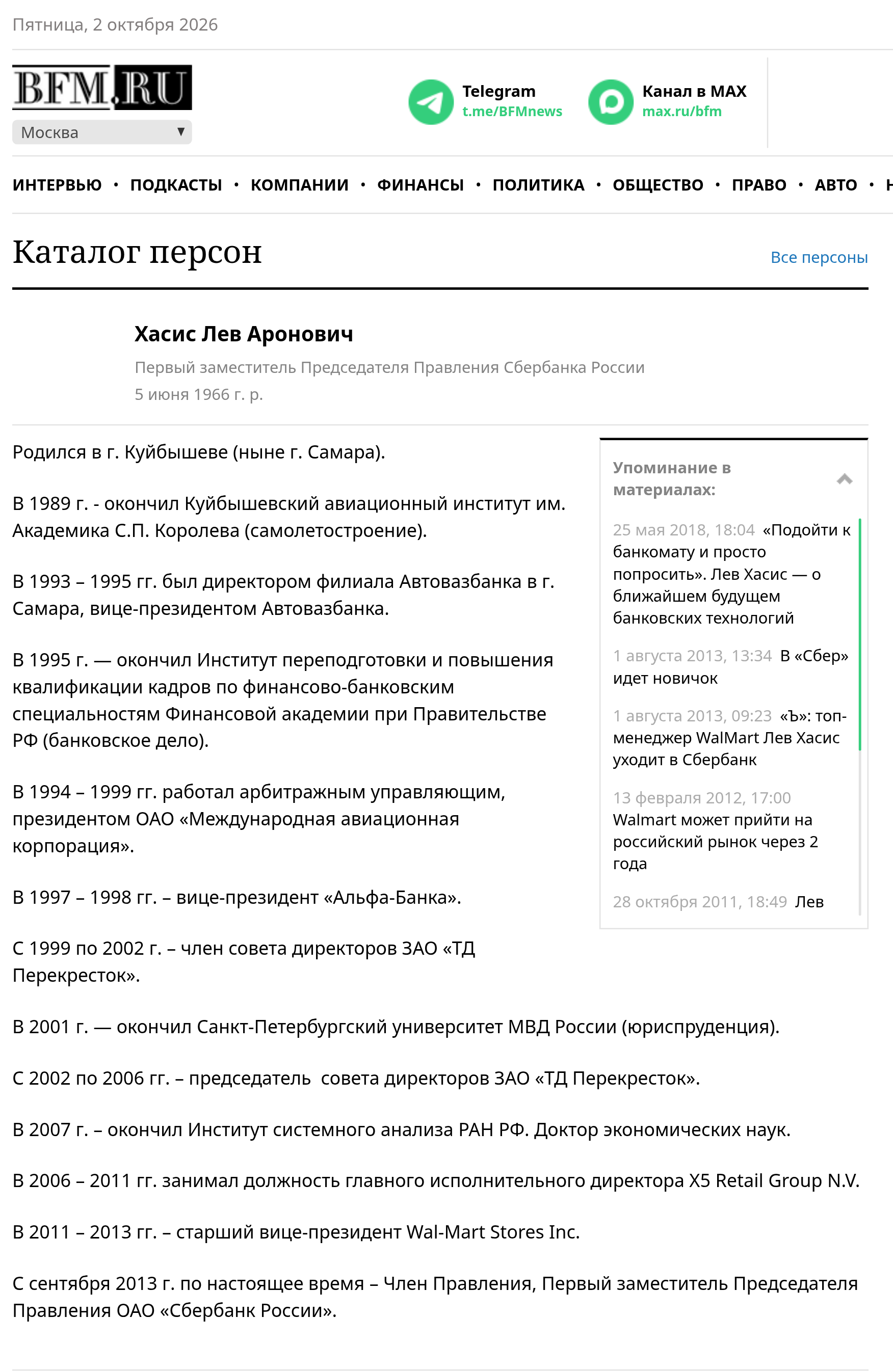
The result of this "digital DIY effort" by Lev Khasis is an illusion of a solved problem while all the risks remain. Every time a compliance officer at any international bank searches for the former executive's name, they see a contradictory picture: some sources claim that Lev Khasis lives in the US and deals in real estate, while others report that Lev Khasis is First Deputy Chairman of Sberbank's Management Board.

For a cautious analyst, the choice is obvious: better to play it safe and refuse service than risk your reputation. After all, if it turns out the client really is connected to the Russian financial sector, you'd have to explain yourself to regulators, journalists, and shareholders all at once.

It's unclear whether the targeted corrections were the basis for lifting the sanctions, but one thing is certain: they didn't solve the main problem. Lev Khasis and Sberbank remain inseparable in digital space, creating constant risks for any international operations.
So, who outsmarted whom in this standoff? For now, Google is winning 2-1—the first point for imposing sanctions based on outdated information, the second for the compliance check risks that persist to this day. Lev Khasis scored back only one point, and even that—at what cost?
Master Class from Orion Solutions: What Khasis Missed
Khasis' attempt to fix the situation was like patching a leaky roof: plug one hole and it starts leaking somewhere else. The problem isn't a poor understanding of the task, but a fundamental underestimation of its scope. A few publications on secondary resources isn't a Digital Profile—it's attempting cosmetic repairs where you need major reconstruction.
The Orion Solutions team receives similar requests from clients daily: "Place a couple of current articles and Google will understand," or "Clean up the internet negativity and the problem will be solved." Both approaches are equally flawed. First, the idea of "cleaning up" the internet is fundamentally flawed: information published online once stays there practically forever. Attempts to delete data are often futile and can backfire, leading to new links with unwanted information. Second, targeted publications on obscure resources can't compete with the mass of materials in federal media, where years after circumstances changed, the “Lev Khasis—First Deputy Chairman of Sberbank's Management Board" connection still exists.
Professional Digital Profile management requires a comprehensive approach. According to Orion Solutions, this includes:
- auditing all mentions in Russian and international internet spaces
- analyzing international databases like World-Check and Dow Jones, where profiles are formed for compliance checks
- systematically placing current information on authoritative platforms
- recommendations for working with encyclopedic resources, including Wikipedia in different languages
- continuous monitoring of the information field and rapid response to changes
The difference in approaches becomes obvious when comparing working methods:
| Criteria | Non-Professional Approach | Orion Solutions Approach |
|---|---|---|
| Material content | General and abstract information that doesn't answer key questions about current status | Information needed for compliance checks that doesn't create additional risks |
| Quality of sources in Russian internet | Third-rate publications, low-quality forums | Authoritative federal media |
| Quality of sources abroad | Free aggregators, spam sites, posts on irrelevant forums, publications in third-rate tabloids | Regional business publications |
| Result measurability | Abstract "negativity reduction" without concrete figures and timeframes | 0 unwanted links on first two pages within 2-6 months |
Khasis' main mistake was an insufficient understanding of how modern compliance systems work. International bank analysts don't limit themselves to superficial searches: they use specialized databases, cross-references, multiple sources. Contradictory information isn't a reason for them to dig into nuances—it's a signal to refuse service.
"33% of profiles in international databases contain serious errors," notes the founder of Orion Solutions Ivan Safonov. They can only be corrected through systematic work, not targeted publications. The Lev Khasis case clearly confirms this argument: DIY efforts create an illusion of solving the problem, while real risks remain critically high.
Why Cutting Corners Costs Triple in the Digital Age: The Case of Former Sberbank Executive Lev Khasis
Lev Khasis has already paid twice for the same mistake. The first time when three countries' sanctions froze his assets and destroyed business relationships due to outdated information on Google. The second when the former banker independently tried to correct his digital Profile, spending time and resources on targeted fixes that only created the illusion of a solved problem. But he may get a third bill: new banking service rejections, problems with international operations, and complications in business negotiations every time compliance officers stumble upon contradictory data in search engines.
Yet a preventive and systematic approach to building an online presence would have cost significantly less than years under sanctions combined with the risks that persist to this day. But most businessmen, including Lev Khasis, prefer to ignore digital security until disaster strikes.
However, the three conditional payments are just a metaphor. In the era of Google justice, it's time to understand: in a world of algorithms, the penny-pincher doesn't just pay twice—he keeps paying until he understands and accepts the new rules of the game.


