


Sergey Stognienko has joined the growing roster of Russian businessmen whose sanctions cases are being analyzed by the Orion Solutions team. What makes Stognienko's case remarkable is that it represents a total information gap. Here's a figure with no photos, no interviews, no biography—a media ghost that Google could tell you only one thing about: in 2016, Sergey Stognienko became head of Trust Bank.
In British sanctions documentation, Sergey Stognienko, Otkritie Bank, and Trust Bank found themselves linked not by evidence, but by the absence of it. Outdated information from the first page of search results was taken as the basis for a full year of restrictive measures. The former Deputy Chairman of Trust Bank's board perfectly illustrates a modern paradox—when zero information serves as the smoking gun.
The UK sanctioned Sergey Stognienko for choosing silence instead of clarifying that he had no connection to the sanctioned Otkritie Bank. His fellow victims—Titova, Golikov, Shulgin, and other Russian businessmen—tried to fix things after the fact and also lost to the algorithms. The lesson is clear: in the age of digital vetting, you should not let outdated data tell your story for you.
Once again, we have examined in detail how the lack of a proper Digital Profile creates a sanctions trap, and why, when algorithms rule the day, staying off the radar is equivalent to an admission of guilt.
Sergey Stognienko and Trust Bank: A Cameo Role with Lasting Consequences
Trying to find information about Sergey Stognienko on Google is like an archaeological dig—you have to piece together the story from rare fragments. The basic timeline of his pre-sanctions saga is given in the table below:
| Date | Event | Public Coverage |
|---|---|---|
| December 2014 | Otkritie becomes an investor for Trust Bank's rehabilitation | Extensive media coverage |
| June 23, 2015 | Stognienko appointed Deputy Chairman of Trust Bank's Board | Mentioned in trade publications |
| April 1, 2016 | Stognienko appointed Acting Chairman of Trust Bank's Board | Brief mention in business media |
| May 2016 | Stognienko leaves position as Chairman of the Board | Complete media silence |
| August 2017 | Trust Bank joins Otkritie Group | Active media discussion |
The first documented link between Sergey Stognienko and Trust Bank dates to June 24, 2015, when trade publications reported that he had been appointed Deputy Chairman of the Board at a shareholders' meeting the previous day.
A crucial detail: by that point, Trust Bank had already been undergoing rehabilitation for six months, with Otkritie Bank serving as the investor for its financial recovery. This connection between the two institutions would later have serious consequences, ultimately becoming the grounds for the UK's sanctions against Stognienko.

What followed, if the lack of online coverage is any guide, was a year of low-key work in a supporting role at the bank under rehabilitation—no interviews, comments, or public appearances. Stognienko remained invisible to the media, known only to a small circle of banking specialists.
The next—and effectively last—public mention of the executive in this context appeared on April 1, 2016. Sergey Stognienko, Otkritie Bank, and Trust Bank, under rehabilitation, were all mentioned in a single news item about personnel changes within the Group, which noted in passing that Stognienko would serve as Acting Chairman of Trust Bank's Board. This appointment was meant to last only until the primary candidate completed the Bank of Russia's approval process.
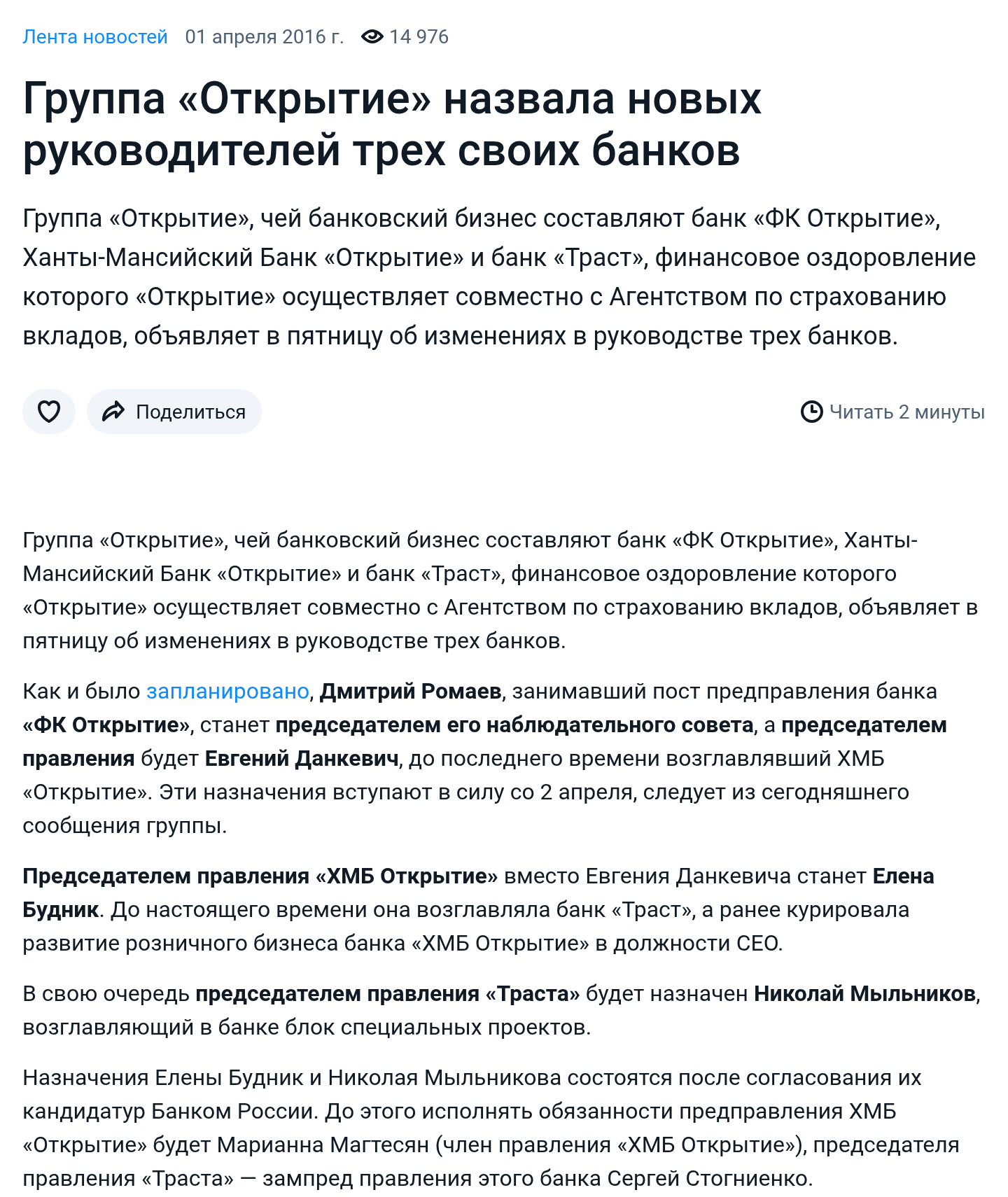
The only way to learn about the end of Stognienko's stint as Acting Chairman in May 2016 and his subsequent career moves is through his profile on zachestnyibiznes.ru. The portal shows his tenure at Trust and his only business activity after banking: in February 2017, he co-founded Chertovka LLC. But a specialized database of Russian legal entities is not exactly something British analysts would find during a quick Google search. For them, the nearly year-long Deputy Chairman position and the open-ended start date as Acting Chairman represent the entire publicly available story of how Sergey Stognienko, Otkritie Bank, and Trust Bank, under rehabilitation, were connected.

Meanwhile, the ties between Trust and Otkritie continued to strengthen. In August 2017, Trust officially joined Otkritie. In 2018, the Group transferred non-core assets to the rehabilitated institution, and in 2022 sold 90% of Tochka JSC shares. According to representatives from both organizations, this last transaction was completed before international sanctions were imposed on FC Otkritie.


Each transaction between Trust and Otkritie only reinforced the impression of their inseparable bond. For British authorities who would later search for anyone connected to the sanctioned bank, this chain of deals would prove crucial.
A Ghost in the Corporate Machine: Why Did Everyone Forget to Mention Former Trust Bank Executive Sergey Stognienko?
Stognienko's appointment as Acting Chairman was mentioned only in passing. His departure was not mentioned at all. This information gap proved fatal.
In our view, this information blackout resulted from the following factors:
- no official press release announcing the end of his tenure as Acting Chairman of Trust
- trade media ignored the personnel change
- no public comments from Stognienko himself
- outdated information on Trust's corporate website
- no biographical materials publicly available
Comparing this to other personnel decisions from the same period reveals just how abnormal the situation was. When Trust officially joined the Otkritie Group, the media covered it extensively. Nikolay Mylnikov's appointment as permanent Chairman after Central Bank approval also made headlines. But Stognienko's work and subsequent departure somehow vanished from the news cycle entirely.
The choice of absolute silence appears deliberate. In an era when you can hire specialists to craft a proper Digital Profile or at least post a standard biography on the corporate website, Sergey Stognienko chose not to exist in digital space at all. As practice shows, this is a fundamentally flawed position.
Sergey Stognienko, Trust Bank, and the information vacuum surrounding his departure made for a dangerous combination. This strategy might have worked in the pre-digital age. But in 2022, when British authorities were searching for connections between the rehabilitated bank and the sanctioned Otkritie, the absence of information worked against the invisible man. Algorithms miss nuance, reducing everything to binaries: if Sergey Stognienko was mentioned as Trust's executive and there is no departure data on the first pages of search results, then he must still be working there.
UK Sanctions Against Sergey Stognienko: Analyzing the Error
On September 26, 2022, Sergey Stognienko and Trust Bank were linked in UK Treasury sanctions. The grounds given for restrictions were succinct: "member of the board of Otkritie Bank." The problem is that Sergey Stognienko never worked there. Essentially, Stognienko was placed under UK sanctions based on a single outdated link—that same 2016 news item about his temporary appointment at Trust.

Sanctions screening follows a simplified process. OFSI (Office of Financial Sanctions Implementation) analysts at the UK Treasury use a standard toolkit: search engines, international databases like World-Check, and open sources from the first page of Google results. The depth of verification is minimal, the speed of decision-making is maximal.
For Stognienko, the British regulators' logic went like this:
- Otkritie has been under sanctions since February 2022
- Trust is closely tied to Otkritie (rehabilitation, asset transfers)
- Sergey Stognienko is a Trust executive according to the first search results
- Therefore, he is connected to the sanctioned bank
It is clear that Stognienko received UK sanctions based on a cursory analysis of the first search page, which contained information about his connection to Trust. Once again, Western authorities’ carelessness shows the strange timing of the decision: the UK Treasury sanctioned Stognienko after a minute of analysis. It took a year to correct this mistake.
Information Vacuum Syndrome: Why Stognienko Is Not Alone
Sergey Stognienko's story is just one of many in the collection of sanctions mix-ups. Elena Titova and Andrey Golikov from Otkritie's Supervisory Board also fell victim to digital silence. They left their posts in April 2022, but US regulators sanctioned them anyway—outdated Google results carried more weight than official resignation documents.
Alexander Shulgin spent a year and a half proving to European officials that he no longer ran Ozon. Dmitry Pumpyansky spent three years convincing the European Court that he had left TMK and Sinara Group before sanctions were imposed. Alexey Fisun sought removal from lists where he appeared for his Sovcombank Supervisory Board membership, which had already ended. In all these cases, the problem was that the information vacuum filled with outdated data while the truth remained buried, receiving insufficient attention.
Farhad Akhmedov faced an even more absurd situation. The EU Council used excerpts from a blogger's fiction book and publications from websites already listed for sale as evidence against him. The UK Treasury followed the same playbook when sanctioning Stognienko—they used whatever little they found on the first page of a search.
Our experience analyzing such cases shows that authorities building sanctions dossiers will use "evidence" of even the most dubious quality:
- social media posts from any time period
- articles from open encyclopedias with anonymous authorship
- news aggregators with unverified content
- corporate directories that have not been updated for years
In other words—any mentions on the first pages of Google, regardless of quantity or quality.
Piecemeal fixes don't work. Vladimir Rashevsky tried to reshape his online narrative regarding SUEK and EuroChem, but this approach backfired—the gaps he created filled with even worse information. The solution? Hire professionals to build a Digital Profile where accurate, current information is not just out there somewhere but dominates search results.
Sergey Stognienko's UK Treasury Sanctions Lifted: One Year Later
On November 9, 2023, the UK Treasury removed Stognienko from its sanctions lists. This formal victory over bureaucratic error took 13 months. During that time, the invisible man was radioactive for any international operations.
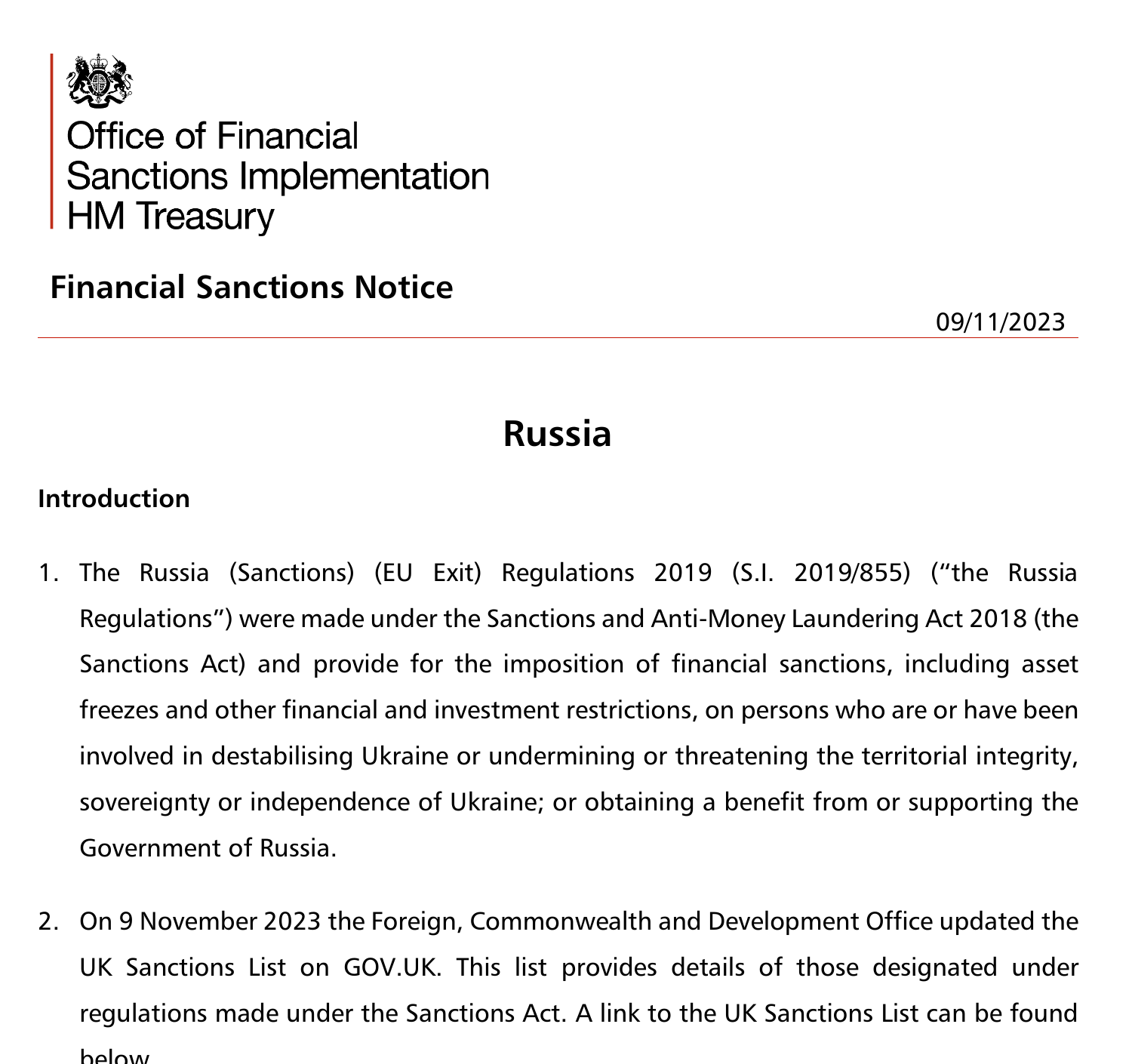
A year under UK sanctions meant the standard package of restrictions: frozen assets, blocked accounts, denial of banking services. Every compliance check created obstacles—financial institutions saw the same outdated information in their databases, where Sergey Stognienko, Trust Bank, and his supposed position continued to register as fact across all verification systems.
Today the sanctions are lifted, the restrictions canceled—time to rest easy, right? But the formal victory has not fixed the core issue. Search results still show Sergey Stognienko linked to Otkritie Bank as if it were fact, right alongside articles from Kommersant, TASS, and Gazeta.ru announcing his removal from UK restrictions lists.

Below are the available archived documents from Trust's official website, which also continues broadcasting seven-year-old information. Meanwhile, data about Stognienko leaving the bank's Board of Directors is nowhere to be found on the first pages of search results.


Stognienko's current activities remain unknown. After founding Chertovka LLC in 2017, the businessman's trail goes cold. With this kind of Digital Profile, he risks hitting snags when trying to open a foreign account or apply for a visa—compliance officers will see that Sergey Stognienko and Otkritie Bank are linked in sanctions history, while current information about his status simply does not exist for them.
Algorithms cannot distinguish past from present—they only see what appears on the first page of Google. And there, the ghost of 2016 still lives.
Learning from the Invisible Man's Mistakes
Stognienko's story demonstrates an extreme form of information vulnerability. His start as Acting Chairman in 2016 was the only biographical fact available to British regulators. That was enough for a year of international restrictions. Yet Sergey Stognienko could have avoided the sanctions trap if he had taken care of his Digital Profile in time, posting an updated biography and news about leaving Trust and talking about new projects.
"If you do not tell your story, someone else will tell it for you," emphasizes the founder of Orion Solutions Ivan Safonov. In Stognienko's case, that story was told by outdated 2016 links, and sanctions authorities believed them.
The invisible man's case is a wake-up call: keeping a low profile no longer protects you. When decisions are based on whatever pops up on the first pages of Google, missing information works against you. The indirect link between Otkritie Bank and Sergey Stognienko existed only in outdated publications, but that was enough to trigger sanctions.
Today, even after sanctions were lifted, Sergey Stognienko remains prisoner to his own strategy of invisibility. The first pages of search engines know exactly three facts about him:
- he worked at Trust for a year, taking an executive position there in 2016
- he founded the mysterious Chertovka in 2017
- he spent a year under sanctions
His modern biography fits into three lines—less than an intern's resume. In today's world, where algorithms determine fates and compliance officers trust only what pops up first on Google, a person without a Digital Profile is doomed to forever explain away ghosts from the past.


